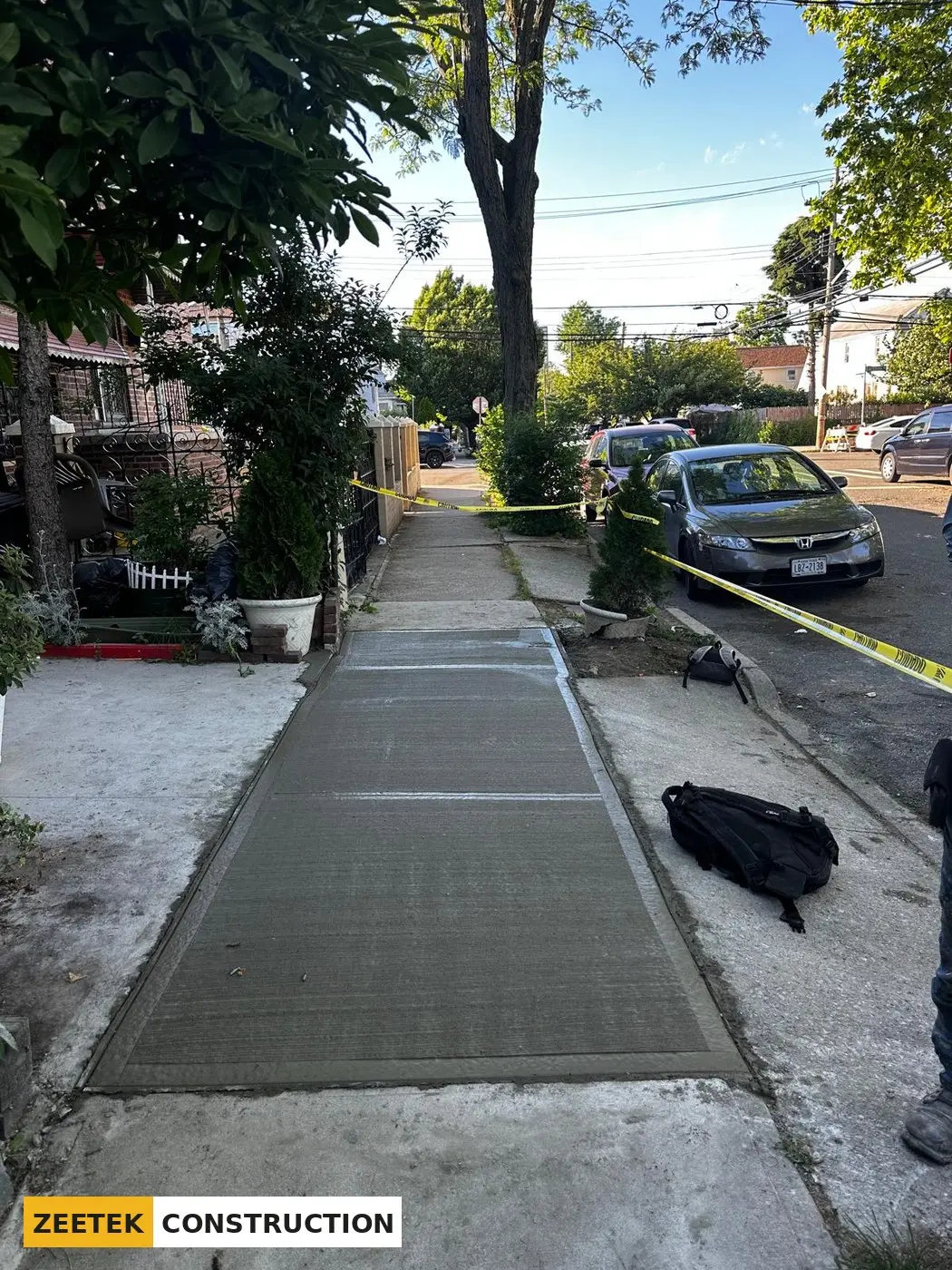
What a sidewalk violation actually is
A Notice of Sidewalk Violation is DOT’s official finding that the sidewalk in front of your property is defective. It does not come with a fine, and it is not a court summons. What it does is put a copy on file with the County Clerk, where it stays until the city tells the Clerk that satisfactory repairs were made. Title searches find it, which is why violations surface at the worst moment: when you are selling or refinancing.
The notice comes with a Preliminary Inspection Report, a sketch of your frontage with flags numbered and defects marked. That sketch is the scope of work. Read it carefully, because it decides what you pay for.
The 75-day clock
- The 75 days start on the date on the certified-mail receipt, or on the posting date if the notice was posted on the property.
- They run the same in January as in June. Weather is not an extension.
- A permit does not extend them either.
- If you receive more than one notice, the newest supersedes the earlier ones.
After 75 days, DOT may send its own contractor and the Department of Finance bills you. The estimate is simple arithmetic, the square footage on the report times the per-square-foot rate in the letter, but the final bill can include additional repairs needed to bring the sidewalk to standard, and interest is added after 90 days unpaid. Doing it yourself, through a contractor you chose, gives you control of the price, the schedule and the finish.
How we clear a violation
- Read the report with you. Send a photo of the notice and the sketch. We match each numbered flag to the frontage and flag anything that does not match, such as a tree, cellar door or utility cap drawn in the wrong place.
- Check whether you should be paying at all. If the damage comes solely from city tree roots in front of a one-, two- or three-family home, the city’s tree-damage rules may apply. If a utility or another contractor broke the sidewalk, their claims department is the place to start; DOT’s permit search shows who worked at your address.
- Price the exact flags. Your written estimate lists every numbered flag, the slab thickness (4 inches, or 7 at driveways and corners), the base, the permit and disposal.
- File the permit and call 811. The contractor must apply for the sidewalk permit through nycstreets.net, so we do. New York 811 is notified at least two full working days before we dig.
- Replace every numbered flag. To the specification in 34 RCNY § 2-09, cut on joint lines, on a proper 6-inch base, sloped to drain to the curb.
- Hand you the dismissal details. Permit number, block and lot, violation number: everything 311 asks for when you request the Sidewalk Violation Dismissal Inspection.
- Keep the sidewalk clear for the inspector. The whole sidewalk must be visible on inspection day. A parked car over one flag can mean a repeat visit.
If the report is wrong
Inspectors make mistakes, and the city has a process for it. If the defect on the notice does not match the actual condition, request a re-inspection through 311 within 75 days of receiving the notice. Check the sketch’s width and dimensions and the positions of trees, signs, utility caps and cellar doors. DOT schedules the re-inspection within 180 days. It is done by a different inspector who does not see the first report, you get at least five days’ notice by mail, the inspector will not knock, and it is the final inspection. If the violation was sent to the wrong owner, that is also a 311 appeal.
Curbs during violation work
A broken curb is not always on your bill. DOT may replace a missing or defective curb at no cost to the owner when it is doing violation-related sidewalk work, or where an active curb repair contract covers the block. If you want the curb done with your flags anyway, our curb repair page explains the options.
Why owners choose to fix it themselves
The city’s contractor will fix the sidewalk, but you do not choose the date, the finish or the extent, and the bill arrives afterwards. A private repair lets you replace adjacent flags that are about to fail, match the finish to the rest of the block, and get the County Clerk filing cleared on your timeline. For the full owner’s walk-through, read our guide to clearing an NYC sidewalk violation.
What it costs in NYC
| Work | Our typical range | NYC market range | What moves it |
|---|---|---|---|
| Concrete sidewalk replacement (4 in. slab on 6 in. base) | $12.50–$22.50 per sq ft | $14–$25 per sq ft | Most residential frontages fall in the middle of this range |
| One standard flag (about 5 ft × 5 ft) | $315–$560 per flag | $350–$625 per flag | Small jobs carry a minimum charge |
| NYC DOT sidewalk permit | $70 per 300 linear ft | — | City fee; corner and through lots can need more than one permit |
Our ranges are set about 10% below the typical New York City market ranges published in the cost guides listed here (checked 2026-11-27). City permit fees are passed on at cost and are not discounted. A range is a guide, not a quote: your price is the figure on your free written estimate, which lists every item and what it excludes. Market sources: NYC DOT sidewalk page (permit fee), Zicklin Contracting, sidewalk violation removal, Constro Facilitator, NYC sidewalk repair guide, Eden Concrete Contractors, sidewalk page.
Where we do this work
Our crews work in all five boroughs from our base in the Bronx. Each borough page explains what is different about its streets, houses and paperwork:
- Sidewalk violation removal in the Bronx — The Bronx is our home borough: our office is on Olinville Avenue in 10467.
- Sidewalk violation removal in Queens — Queens is house country: nearly four in five lots with a building are one- and two-family homes.
- Sidewalk violation removal in Brooklyn — Brooklyn has the oldest building stock of the outer boroughs and the most walk-up and mixed-use buildings in the city.
- Sidewalk violation removal in Manhattan — In Manhattan the sidewalk is mostly in front of apartment buildings, storefronts and townhouses, owned by boards, landlords and managing agents.
- Sidewalk violation removal in Staten Island — Staten Island is the borough of detached houses: more than nine in ten lots with a building are one- and two-family homes, and most were built after 1940.
Questions we get asked
Is there a fine for a sidewalk violation?
No. NYC DOT states that no fine is associated with a Notice of Sidewalk Violation. The real costs are the County Clerk filing, which can complicate a sale or refinance until the repair is accepted, and the city's own repair bill if you let the 75 days run out.
When do the 75 days start?
On the date shown on the certified-mail receipt. If the notice was not mailed, it is posted on the property and the posting date starts the clock. The period is the same all year, and a sidewalk permit does not extend it.
What happens if I miss the deadline?
DOT may hire its own contractor to do the work, and the Department of Finance bills you. You then have 90 days to pay before interest is added and a lien is placed on the property. The bill is estimated from the square footage on the inspection report times the city's contract rate, and the final bill can include extra repairs.
Do I have to replace flags that look fine?
You have to replace every flag that carries a number on the Preliminary Inspection Report and correct every listed defect. If the report does not match what is actually there, you can ask for a re-inspection through 311 within 75 days of receiving the notice.
How does the violation get removed from my record?
After the repair, you or your contractor ask 311 for a Sidewalk Violation Dismissal Inspection, with the permit number, address, block and lot, violation number and the owner's contact details. A DOT inspector checks the work. The whole sidewalk must be visible, so cars, bins and materials need to be off it that day.
My violation was caused by a street tree. Do I still have to pay?
If you own a one-, two- or three-family property and the damage was caused solely by city trees, DOT no longer issues violations, has reviewed old ones and cancels qualifying liens, and owners are not charged for the repair. Contact 311 about the Trees and Sidewalks Program before paying for that work.