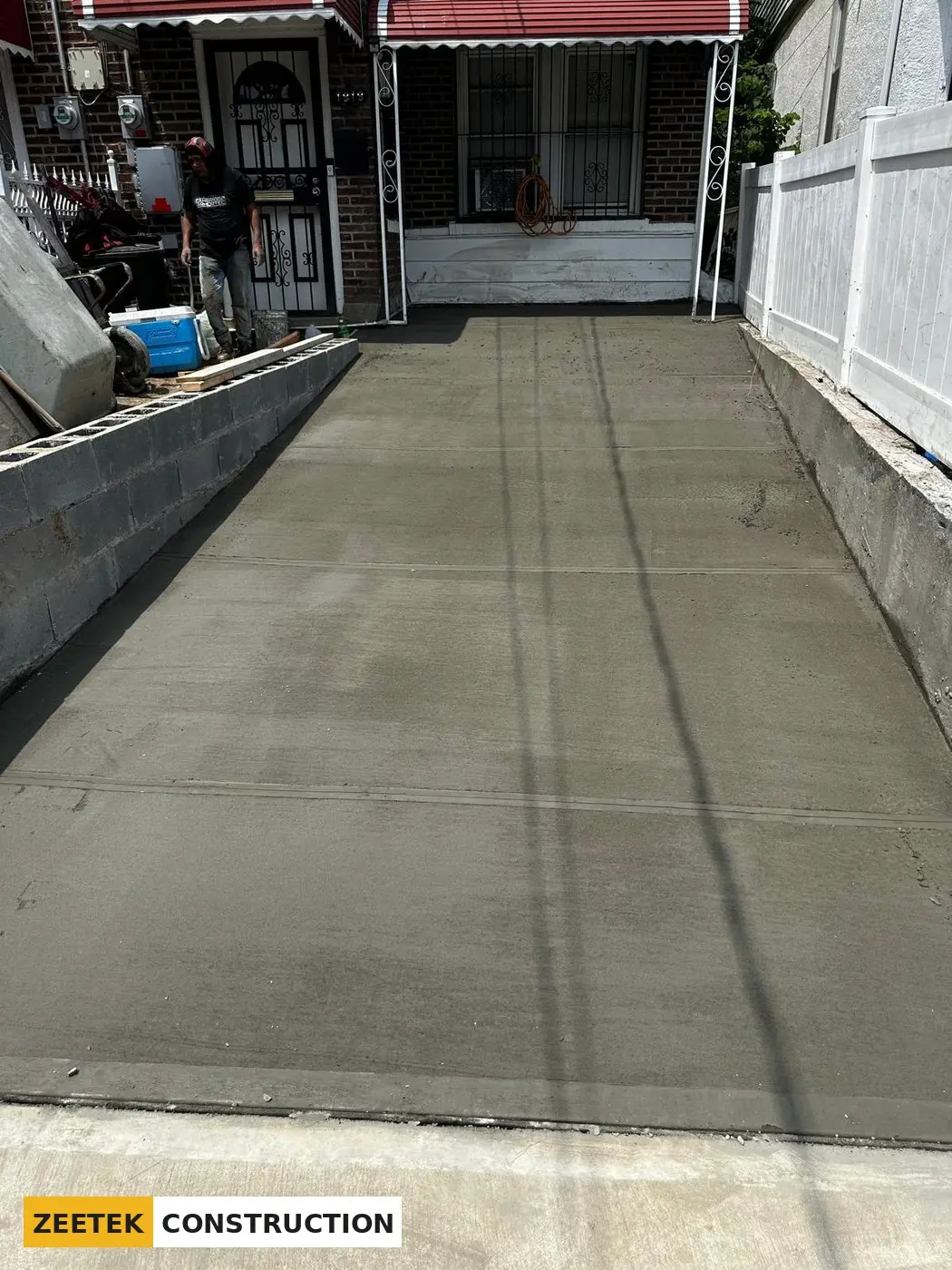
What makes a driveway last in New York
A concrete driveway in New York lives a hard life: freeze and thaw every winter, de-icing salt, delivery trucks that are heavier than the family car, and in much of the city, a narrow strip between two houses that has to shed water away from both foundations. Almost every failed driveway we break out failed underneath, not on top. So that is where our estimates start.
The base
Soft fill, old cinders and clay hold water, freeze and heave. We dig out to firm ground, then build up and compact a granular base so the slab sits on something that drains and does not move. Where a driveway sank before, we find out why: a leaking leader, a washed-out trench, roots.
Thickness and reinforcement
A driveway carries point loads from tyres and jacks, so it is poured thicker than a walk. Across the public sidewalk the city fixes the number, 7 inches of concrete on a 6-inch foundation under 34 RCNY § 2-09. On your lot we size it to what will park there and the soil, and your estimate names the thickness and the reinforcement.
Joints
Concrete shrinks as it cures and moves with temperature. Tooled or saw-cut control joints at regular intervals, tied to the slab thickness and width, make it crack in straight lines inside the joints instead of wandering across the panel. Where the driveway meets the garage slab, the house or the sidewalk, an isolation joint lets each piece move on its own.
Drainage
Between attached houses there is no room for water to go anywhere but where you send it. We set the forms so the slab falls toward the street or a drain, and away from both foundations. If a drain or a connection to the sewer is needed, that is licensed plumbing work, which we bring in a licensed subcontractor for and show separately on the estimate.
Finish and curing
A broom finish gives grip in the wet and in winter. Stamped or coloured concrete is available where you want a decorative surface. Then the slab is cured and protected; concrete that freezes before it sets, or gets salted in its first winter, is the most common cause of a flaking surface.
Replace, repair or resurface?
- Replace when panels have sunk, heaved or broken up, or when water ponds against the house. The base has failed; new concrete on top will follow it.
- Repair when one panel is broken or one corner has dropped and the rest is sound. We saw-cut it out to the joints and pour a new panel.
- Resurface only for surface scaling on an otherwise sound, level slab. A thin overlay on a moving slab cracks along the old cracks within a season or two.
Curb cuts: the part that needs the Department of Buildings
If your driveway is new, or you want to widen the dip in the curb, the curb cut is a separate approval. A curb cut is an encroachment on the public right of way, and the Department of Buildings must approve the plans before it issues a work permit. In outline:
- A New York State licensed Professional Engineer or Registered Architect files the plans in DOB NOW: Build, with the zoning analysis. Zoning sets the curb cut and driveway dimensions; in many residential districts a curb cut must be at least 8 feet wide including splays.
- Where the new driveway and parking space together exceed 200 square feet, the drawings must also show stormwater drainage.
- DOB issues curb cut permits only to a licensed General Contractor, and a separate DOT permit covers the work in the street.
- The project is closed with inspections and a final survey by a licensed land surveyor.
Illegal curb cuts collect multiple violations and are expensive to put right. Our curb cut guide goes through the sequence step by step. The design professional prepares and files the plans; as a registered General Contractor, we pull the DOB work permit and the DOT permit and build to the approved drawings.
What a driveway job looks like
- Site visit, measurements and photos; we check the curb, the sidewalk section and the drainage.
- Written, itemised estimate: removal, base, thickness, reinforcement, joints, finish, permits, disposal and exclusions.
- Permits filed where the work crosses the sidewalk, and New York 811 called at least two full working days before we dig.
- Break-out and haul-away, base built and compacted, forms set to fall.
- Pour, finish, joint and cure. The driveway stays closed to cars until the date on your schedule.
Thinking about cost first? Our driveway cost guide breaks down what moves the price in NYC.
What it costs in NYC
| Work | Our typical range | NYC market range | What moves it |
|---|---|---|---|
| Concrete driveway, broom finish, old slab removed | $9–$18 per sq ft | $10–$20 per sq ft | |
| Stamped or coloured concrete driveway | $13.50–$22.50 per sq ft | $15–$25 per sq ft | |
| Typical NYC driveway project | $4,850–$10,800 | $5,400–$12,000 | Size, removal, base repair and access move the total most |
| New curb cut (DOB and DOT permits, design professional) | Priced after the drawings exist | — | Permit and design fees are separate from the concrete |
Our ranges are set about 10% below the typical New York City market ranges published in the cost guides listed here (checked 2026-11-27). City permit fees are passed on at cost and are not discounted. A range is a guide, not a quote: your price is the figure on your free written estimate, which lists every item and what it excludes. Market sources: Angi, concrete driveway cost (New York, NY), HomeBlue, concrete driveway cost in New York, NY, HomeGuide, concrete driveway cost.
From our jobs


Where we do this work
Our crews work in all five boroughs from our base in the Bronx. Each borough page explains what is different about its streets, houses and paperwork:
- Concrete driveways in the Bronx — The Bronx is our home borough: our office is on Olinville Avenue in 10467.
- Concrete driveways in Queens — Queens is house country: nearly four in five lots with a building are one- and two-family homes.
- Concrete driveways in Brooklyn — Brooklyn has the oldest building stock of the outer boroughs and the most walk-up and mixed-use buildings in the city.
- Concrete driveways in Manhattan — In Manhattan the sidewalk is mostly in front of apartment buildings, storefronts and townhouses, owned by boards, landlords and managing agents.
- Concrete driveways in Staten Island — Staten Island is the borough of detached houses: more than nine in ten lots with a building are one- and two-family homes, and most were built after 1940.
Questions we get asked
How thick should a concrete driveway be?
On the public sidewalk, the city sets it: 7 inches of concrete on a 6-inch foundation where a driveway crosses, under 34 RCNY § 2-09. On your own lot there is no single city number; the right thickness depends on what will park on it and the ground beneath. Your estimate states the thickness, base and reinforcement for your driveway.
Do I need a permit for a new driveway?
Replacing an existing driveway inside your lot is generally straightforward, but the section across the sidewalk needs a DOT sidewalk permit. Creating a new curb cut is a Department of Buildings matter: plans filed by a licensed engineer or architect, a DOB permit issued to a licensed General Contractor, and a separate DOT permit for the street work.
How long before I can drive on a new concrete driveway?
Walking is usually fine within a day or two, but cars should wait until the slab has gained enough strength, which takes days, not hours, and longer in cold weather. We tell you the date in writing for your pour.
Can a cracked driveway be repaired instead of replaced?
Fine surface cracks can be sealed, and a single broken panel can be cut out and replaced. If the driveway has sunk or broken up across several panels, the base has usually failed, and resurfacing or patching just puts new concrete on a bad foundation. We tell you which case you have.
Concrete or pavers for a driveway?
Concrete costs less per square foot and gives one continuous slab. Pavers cost more but can be lifted for repairs and relaid. Our concrete vs pavers guide compares them for NYC conditions.