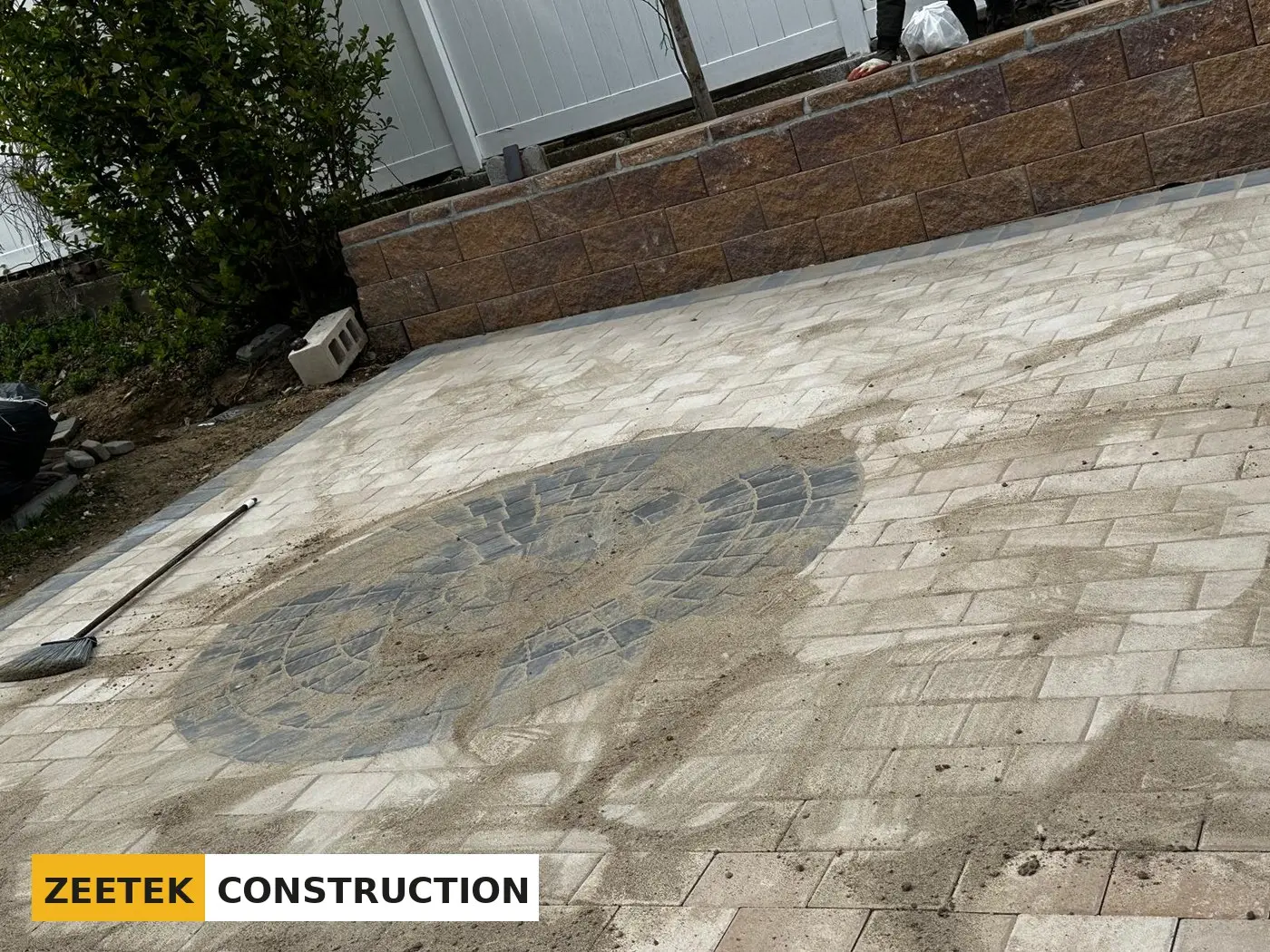
A paver job is a base job
Pavers themselves are the easy part. A patio or walk stays flat for years only if what is underneath it is deep enough, compacted in layers, and drains. In New York the ground under a backyard is often old fill, cinders or clay that holds water and heaves in a hard freeze. We dig that out.
- Excavate to firm ground, deeper for driveways than for walks.
- Lay fabric where the soil is soft, so the base does not sink into it.
- Build and compact the base in layers of crushed stone, each one compacted, not dumped in one go.
- Screed the bedding layer to an even depth so every paver sits at the same height.
- Lay the pattern with consistent joints, cutting edge pieces cleanly.
- Set the edges. Edge restraint stops the field from spreading, which is how joints open and pavers rock.
- Compact and fill joints with sand, so the pavers lock together.
Concrete, brick and natural stone
- Concrete pavers. The most common choice: consistent sizes, many colours and shapes, and they interlock tightly.
- Brick. The classic look on many NYC row-house fronts and yards. Clay brick holds its colour for decades.
- Natural stone. Bluestone, granite and other stones for a premium patio or walk. Thickness and cutting add cost.
Re-levelling and repair
Sunken areas, rocking pavers and weeds in the joints all point back to the base. We lift the affected area, rebuild the base, and relay the same pavers where they are sound, adding matching units for broken ones. Where tree roots have lifted pavers, we work around the roots; cutting the roots of city street trees is prohibited, and on your own lot cutting large roots can kill the tree.
Pavers on your lot, concrete on the sidewalk
The public sidewalk in front of your property is concrete by city standard. Other materials there count as distinctive paving and need city approval. So pavers belong on your side of the property line: front walks, patios, driveways, steps and paths. We build them so they meet the public sidewalk with a clean edge and no lip.
Choosing between pavers and poured concrete
If you are deciding between the two for a patio or driveway, our concrete vs pavers guide compares cost, repair, winter performance and looks. For a poured slab, see concrete patios and concrete driveways.
What it costs in NYC
| Work | Our typical range | NYC market range | What moves it |
|---|---|---|---|
| Concrete paver patio or walkway, installed on a new base | $18–$31.50 per sq ft | $20–$35 per sq ft | |
| Natural stone or brick pavers | $22.50–$40.50 per sq ft | $25–$45 per sq ft | |
| Paver repair and re-levelling | $7.20–$13.50 per sq ft | $8–$15 per sq ft | Lift, rebuild the base, relay the same pavers |
Our ranges are set about 10% below the typical New York City market ranges published in the cost guides listed here (checked 2026-11-27). City permit fees are passed on at cost and are not discounted. A range is a guide, not a quote: your price is the figure on your free written estimate, which lists every item and what it excludes. Market sources: HomeBlue, paver patio cost in New York, NY, LawnStarter, paver patio price (New York, NY), Angi, paver patio cost.
From our jobs


Where we do this work
Our crews work in all five boroughs from our base in the Bronx. Each borough page explains what is different about its streets, houses and paperwork:
- Pavers in the Bronx — The Bronx is our home borough: our office is on Olinville Avenue in 10467.
- Pavers in Queens — Queens is house country: nearly four in five lots with a building are one- and two-family homes.
- Pavers in Brooklyn — Brooklyn has the oldest building stock of the outer boroughs and the most walk-up and mixed-use buildings in the city.
- Pavers in Manhattan — In Manhattan the sidewalk is mostly in front of apartment buildings, storefronts and townhouses, owned by boards, landlords and managing agents.
- Pavers in Staten Island — Staten Island is the borough of detached houses: more than nine in ten lots with a building are one- and two-family homes, and most were built after 1940.
Questions we get asked
Why do pavers sink or become uneven?
Almost always because the base underneath was too thin, not compacted, or does not drain. Water softens it, frost lifts it, and the pavers follow. Re-levelling means lifting the pavers, rebuilding the base and relaying them; topping up sand between joints does not fix it.
Are pavers better than concrete?
They are different. Pavers cost more per square foot, but individual units can be lifted and replaced, which suits areas over utilities or roots. Poured concrete costs less and has no joints for weeds. Our concrete vs pavers guide compares them for NYC conditions.
Can pavers be used on the public sidewalk?
The city standard for sidewalks is concrete. Other materials on the public sidewalk are treated as distinctive paving that needs city approval, so pavers belong on your own lot: patios, walks, driveways and steps.
Can you reuse my existing pavers?
Often, yes. Concrete pavers in good condition can be lifted, cleaned and relaid on a new base, which saves material cost. Broken units are replaced with the closest available match.
Do pavers need sealing?
Sealing is optional. It can deepen the colour and help keep joint sand in place, but it needs renewing every few years. We tell you whether it is worth it for your paver and location.