
When a sidewalk needs repair
New York City sidewalks fail in a handful of predictable ways, and DOT’s own defect list names most of them. Knowing which one you have tells you whether you are looking at a small job or a frontage.
- Trip hazards. One flag lifted ½ inch or more above its neighbour, DOT’s threshold. Street-tree roots, frost heave and settling soil are the usual causes.
- Collapsed or sunken flags. The base underneath has washed out or settled, often over an old utility trench or a leaking drain.
- Cracked and broken flags. DOT counts a full-depth crack, joint to joint, ¼ inch wide or more. A crack lets water into the base; a broken corner becomes a trip hazard within a winter or two.
- Improper slope. A sidewalk should fall gently toward the curb so water drains to the gutter. Flags tilted toward the building send water to your foundation.
- Patchwork. Old patches of asphalt or mismatched concrete are a defect in their own right on DOT’s list, not a repair.
- Hardware trip hazards. A utility cover or cap not flush to within ½ inch of the surface.
You do not need a violation to fix any of these. The owner is responsible for the sidewalk at all times under Administrative Code § 19-152, and potentially liable for injuries under § 7-210. Replacing a trip hazard before someone falls on it is cheaper than the alternative.
How we build a sidewalk that passes
The city does not leave sidewalk construction to taste. The Highway Rules set it out in 34 RCNY § 2-09(f)(4): a single course of concrete 4 inches thick, laid on a foundation 6 inches thick, and 7 inches thick in driveways and corner quadrants. Our estimate names each layer, so you can see you are getting the full section.
- Permit and mark-out. We apply for the DOT sidewalk permit through nycstreets.net, which the rules require of the contractor, and call New York 811 at least two full working days before breaking ground so utility lines are marked.
- Saw-cut and break out. We cut on the existing joint lines so the new flags meet the old ones cleanly, then remove the broken concrete and haul it away.
- Fix the base. Soft or washed-out soil is dug out and replaced with compacted base material to the full 6 inches. Most sidewalks that sink again were poured on a base nobody fixed.
- Form to the right slope. Forms set the height against the curb and the building line and the fall toward the street.
- Pour, finish and score. Concrete goes in to the full depth, is struck off, floated and given a non-slip broom finish. Joints are tooled to match the flag pattern, because concrete shrinks as it cures and will crack where we tell it to, or wherever it chooses.
- Cure and protect. Barriers and tape stay up while the slab gains strength. Concrete that freezes before it has set can be damaged in one night, so cold-weather pours get extra protection.
Concrete, slate, bluestone and pigmented sidewalks
Most residential sidewalks are plain concrete, and that is what DOT’s own contractors use. In some places the material is not your choice:
- Commercial districts. DOT requires pigmented concrete in front of lots in zoning districts C4-4 through C4-7, C5 and C6. If more than half of the sidewalk in front of the lot is being replaced, the new work must be pigmented. The standard does not apply in landmarked historic districts.
- Historic districts. In some Landmarks Preservation Commission districts, historic paving such as bluestone or granite is a protected feature. Removing it can need LPC approval first. We check the district before we price.
- Driveway crossings and corners. These get the thicker 7-inch slab whatever the finish.
Sidewalk repair and tree roots
If a city street tree has lifted your sidewalk, read our tree roots guide before you pay anyone. Owners of one-, two- and three-family properties are not charged for repairing damage caused by a city tree, and DOT no longer issues violations to those properties where city trees are the sole cause. NYC Parks repairs qualifying sidewalks through its Trees and Sidewalks Program. Cutting or shaving the roots of a city tree is prohibited, so no honest contractor will offer to “trim the roots” to make a slab sit flat.
Repair before a violation, or after one
The work is the same either way. What changes is the paperwork and the clock. With a Notice of Sidewalk Violation, you have 75 days from the certified-mail date, every numbered flag on the Preliminary Inspection Report must be replaced, and you need a dismissal inspection afterwards to clear the County Clerk filing. Our violation removal service handles that end to end. If there is no notice, you choose the timing and the extent, and you avoid a lien-style filing appearing on your property in the first place.
What to expect on the day
We barrier the work area so pedestrians can pass safely, keep the sidewalk usable where the frontage allows, and leave the site broom-clean. Driveway sections stay closed to cars for longer than walking areas, because a 7-inch slab still needs time before it carries a vehicle. Your estimate states which parts of the frontage will be closed and for how long.
What it costs in NYC
| Work | Our typical range | NYC market range | What moves it |
|---|---|---|---|
| Concrete sidewalk replacement (4 in. slab on 6 in. base) | $12.50–$22.50 per sq ft | $14–$25 per sq ft | Most residential frontages fall in the middle of this range |
| One standard flag (about 5 ft × 5 ft) | $315–$560 per flag | $350–$625 per flag | Small jobs carry a minimum charge |
| NYC DOT sidewalk permit | $70 per 300 linear ft | — | City fee; corner and through lots can need more than one permit |
Our ranges are set about 10% below the typical New York City market ranges published in the cost guides listed here (checked 2026-11-27). City permit fees are passed on at cost and are not discounted. A range is a guide, not a quote: your price is the figure on your free written estimate, which lists every item and what it excludes. Market sources: NYC DOT sidewalk page (permit fee), Zicklin Contracting, sidewalk violation removal, Constro Facilitator, NYC sidewalk repair guide, Eden Concrete Contractors, sidewalk page.
From our jobs
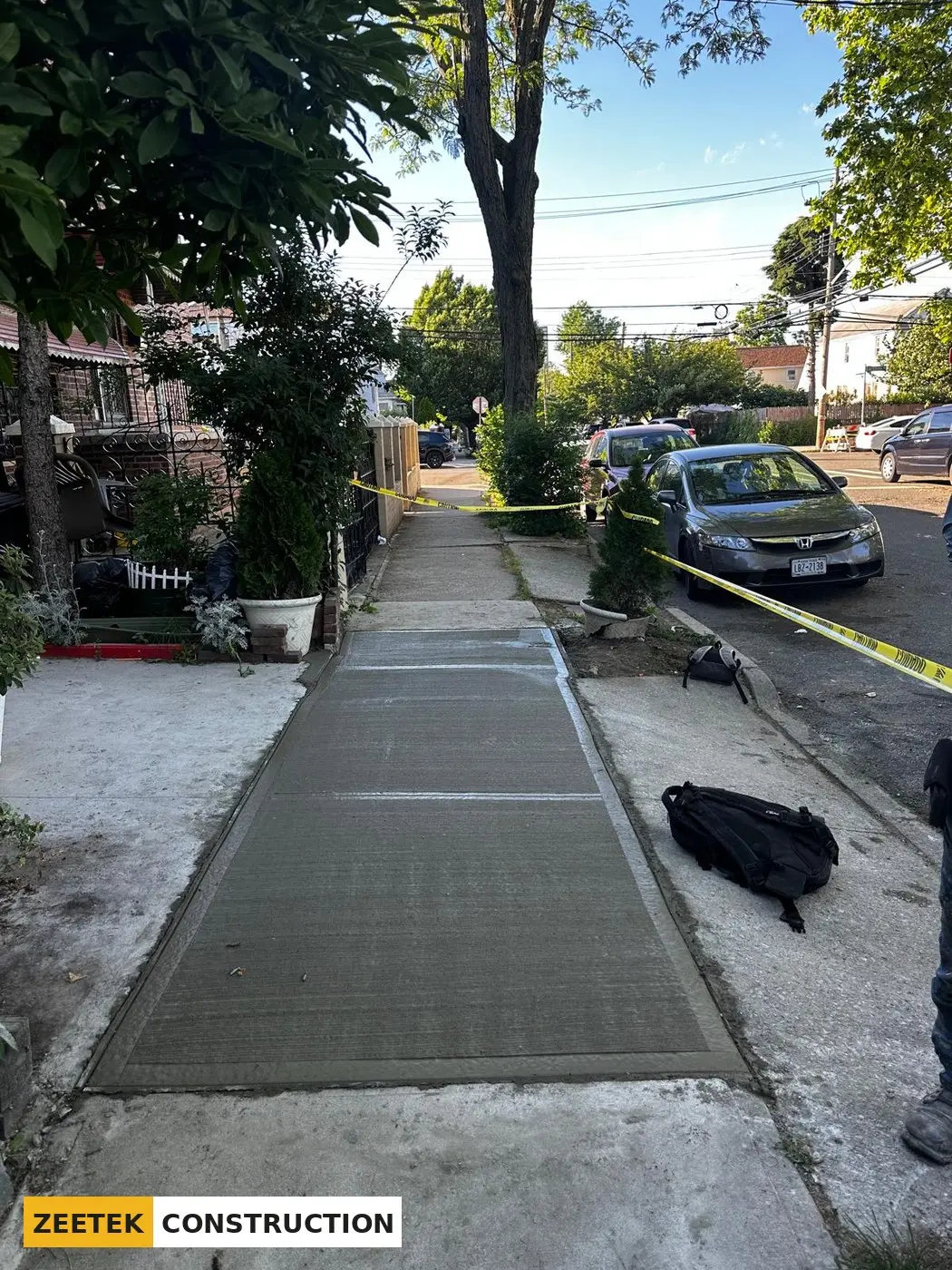


Where we do this work
Our crews work in all five boroughs from our base in the Bronx. Each borough page explains what is different about its streets, houses and paperwork:
- Sidewalk repair in the Bronx — The Bronx is our home borough: our office is on Olinville Avenue in 10467.
- Sidewalk repair in Queens — Queens is house country: nearly four in five lots with a building are one- and two-family homes.
- Sidewalk repair in Brooklyn — Brooklyn has the oldest building stock of the outer boroughs and the most walk-up and mixed-use buildings in the city.
- Sidewalk repair in Manhattan — In Manhattan the sidewalk is mostly in front of apartment buildings, storefronts and townhouses, owned by boards, landlords and managing agents.
- Sidewalk repair in Staten Island — Staten Island is the borough of detached houses: more than nine in ten lots with a building are one- and two-family homes, and most were built after 1940.
Questions we get asked
Who is responsible for repairing the sidewalk in front of my house?
In New York City the adjoining property owner is. Section 19-152 of the Administrative Code makes owners responsible for installing, repairing and maintaining the sidewalk, and Section 7-210 makes most owners potentially liable for injuries caused by a defective sidewalk. The main exception to the repair bill is damage caused solely by city street trees in front of one-, two- and three-family homes.
Can I just patch the cracked part?
Usually not, if you want the work to count. DOT lists patchwork as a sidewalk defect in its own right, and a violation requires every numbered flag on the inspection report to be replaced. We cut out and replace whole flags to the joint lines.
How long does sidewalk replacement take?
The work on site for a typical house frontage is usually a short job: break out, prepare the base, form, pour and finish. The concrete then needs protecting while it cures before people walk on it, and longer before a car crosses a driveway section. We give you the schedule in writing with the estimate.
Do I need a permit to replace my sidewalk?
Yes. A DOT sidewalk permit is needed, at $70 for every 300 linear feet of sidewalk on one property. When a contractor does the work, the contractor must apply through nycstreets.net, so we file it for you. Corner and through lots can need more than one permit.
Can you replace a slate or bluestone sidewalk?
Yes, we replace sidewalks in concrete, which is the city standard. If your property is in a historic district where the original paving is protected, Landmarks Preservation Commission approval may be needed before the old stone is removed; we check that before we price.
What is a trip hazard, and can it be ground down?
A trip hazard is a raised edge between flags, listed by DOT as a defect. Grinding is sometimes offered for small lips on private walks, but on the public sidewalk the reliable fix, and the one an inspector accepts against a violation, is replacing the flags that caused it.